The simplest AI content workflow is a five-stage chain: plan the piece in a project tool, research with a search-enabled assistant, draft in one pass, fact-check every claim against a source, then publish and schedule from a single workspace — and the reason beginners skip steps is that they collapse all five into one prompt.
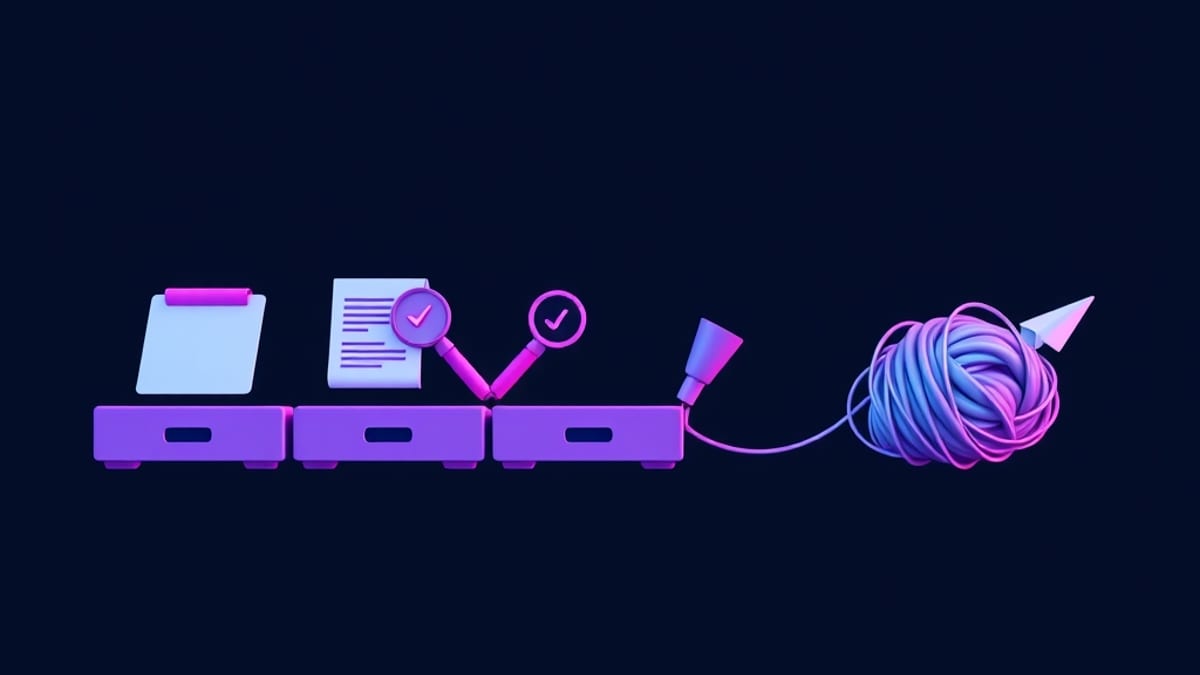
If you want the shortest version that works: pick your topic, ask an AI to outline it, draft section by section, verify each factual claim, then publish. The tools matter less than the order. According to our AI tool database, Notion AI starts at $8 per user per month as an add-on and handles the planning and drafting stages inside the same workspace where your notes already live, which removes the copy-paste step where most beginners lose track of what they have and have not checked.
Why do models skip steps in the first place? Because a language model generates text by predicting what comes next, not by following a checklist. If you ask for "a blog post about email marketing," the model has no reason to stop and verify a statistic before writing it — verification is not part of predicting the next token.
The fix is not a better prompt. The fix is to make each stage a separate job with its own output, so a skipped stage becomes visible. When you ask for research and drafting in the same breath, a missing source looks exactly like a finished paragraph.
When you ask for research alone, a missing source is obvious. That is the whole mechanism, and it explains why staged prompting works better than longer prompts.
Here is the workflow end to end, with the tool layer attached. Stage one, planning: open a page in Notion AI and write the topic, audience, and the one question the piece must answer. Notion AI's Custom Agents can then turn that into a task list and a rough outline, and because it sits inside a database-backed workspace, your outline, notes, and draft stay linked.
Stage two, research: run the outline through a search-enabled assistant and ask for sources, not summaries. Stage three, drafting: paste the outline back into the same Notion page and draft one section at a time. Stage four, fact-checking: go claim by claim and confirm each number against the original source.
Stage five, publishing and coordination: if you work with an editor or a client, Slack AI can summarize the review thread and catch you up on what changed, and for a software team tracking the content as a project, Linear's AI-powered issue creation turns each piece into a trackable item with a deadline. That is the difference between a workflow and a prompt — each stage leaves an artifact the next stage can check.
A concrete example makes this clearer. Say you are writing "How much does Slack AI cost?" You plan in Notion AI and note the required answer: current pricing.
You research and find the vendor page. You draft with the outline visible. You fact-check and confirm, from our AI tool database snapshot, that Slack AI is an add-on with Pro listed at $8.75 per user per month and Business+ at $14.10 per user per month, and that the platform is used across more than 200,000 organizations.
You publish. Notice what did not happen: you never asked one prompt to do all of it, so there was no moment where a fabricated price could slip through unnoticed. If you had asked for the whole post at once, a wrong number would have looked identical to a right one.
Where this workflow fails is worth knowing before you commit. It is slower — five stages take longer than one prompt, and for a 200-word social caption the overhead is not worth it. It also depends on you actually doing stage four; no tool in the chain verifies anything for you, and a search-enabled assistant can still cite a page that does not say what it claims.
Notion AI, Linear, and Slack AI are all priced per user per month, so a solo writer pays for seats built for teams, and pricing on all three changes often enough that the vendor's own page is the only reliable source. The honest trade-off: this workflow buys you accuracy and reproducibility at the cost of speed, and it is worth it for anything published under your name.