Yes, teachers can sometimes tell you used AI, but not reliably — AI detectors work by measuring statistical patterns in your text, and they are probabilistic tools that regularly flag human writing as AI-written, so a positive result is not proof.
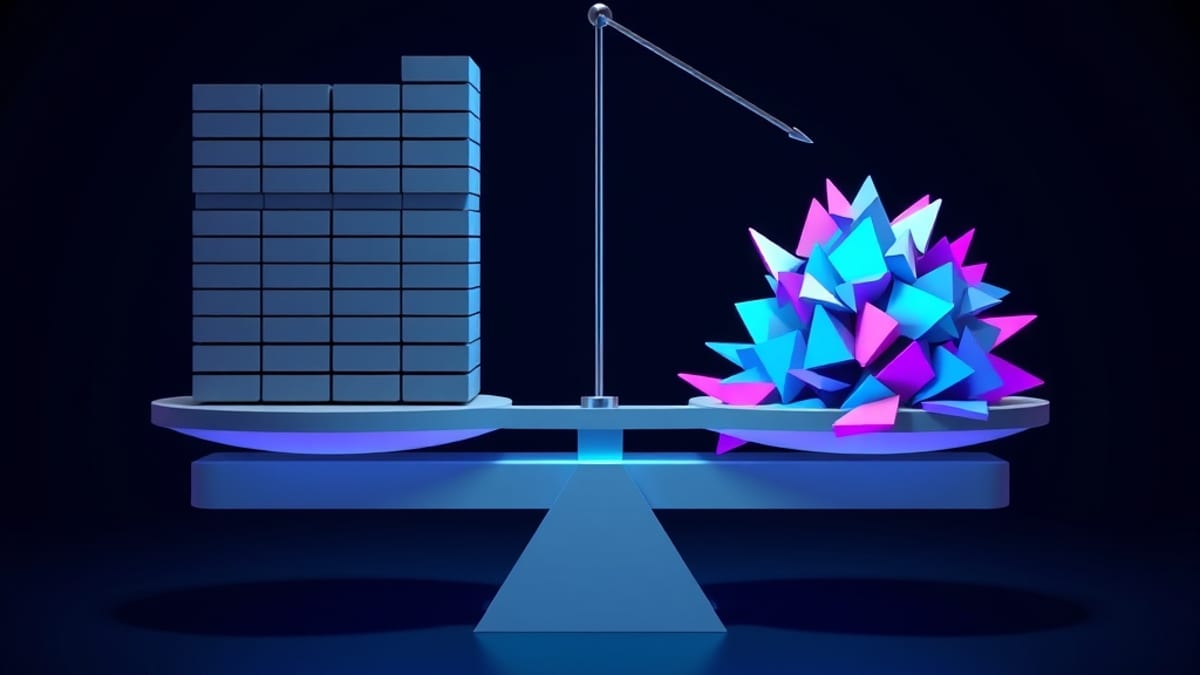
The honest answer is that detection is a guessing game played with math, and the math is wrong often enough that you should never treat a detector score as a verdict.
What actually gets students caught is usually not a detector at all. It is a mismatch: a polished final draft with no drafts behind it, a writing voice that does not match your in-class work, or citations to sources that do not exist.
Here is the mechanism, because understanding it is the only way to reason about your own situation. Detectors do not search a database of AI-written essays and look for a match. They score two properties of your text.
The first is perplexity — roughly, how surprised a language model is by each word you chose. AI text tends to pick the most predictable next word, so it scores as low perplexity. The second is burstiness — how much sentence length and structure vary.
Human writing swings between a three-word sentence and a thirty-word one; AI writing tends to sit in a comfortable middle band. A third approach trains a classifier on labeled examples of human and AI text and asks it to sort yours. All three are statistical.
None of them knows who wrote your essay. They are comparing your writing to a pattern, and patterns overlap.
That overlap is where false positives come from, and it is the part nobody warns you about. Consider a concrete case: a student writes a formal lab report in a second language. Short, grammatically regular sentences.
Limited vocabulary range. Very few contractions. Every one of those traits is also an AI trait, because both a careful non-native writer and a language model are optimizing for correctness.
That student can score as heavily AI-written while having typed every word themselves. The same thing happens to writers with a naturally plain style, to anyone who heavily edits toward clarity, and to anyone whose teacher ran the text through a paraphrasing tool first. Detection accuracy also drops sharply on short texts — a 150-word discussion post gives the classifier almost nothing to work with — and it varies by which detector you use, since each one was trained differently.
So what should you actually do? Treat detection as a risk you manage, not a verdict you argue with. The strongest protection is a visible paper trail: keep your drafts, your notes, your outline, and your revision history.
If your word processor or document tool has version history, leave it on. A folder with an outline, a messy first draft, and two revised versions is far more convincing than any detector score, because it shows process rather than a finished artifact. Second, write in your own voice even when you use AI for something legitimate like brainstorming or checking grammar — the mismatch between your normal voice and a suddenly smooth essay is what draws attention.
Third, if you are allowed to use AI for research, cite the sources you actually read, not sources the AI suggested, because invented citations are the single fastest way to get caught and they have nothing to do with detectors.
Where this advice breaks down: none of it helps if your school's policy bans AI outright and you used it anyway. A paper trail proves you wrote the final draft; it does not prove you followed the rules. It also does not help if you cannot produce drafts because you wrote the essay in one sitting the night before — in that case, be honest about your process rather than scrambling to manufacture evidence, because fabricated drafts are worse than no drafts.
And no amount of process protects you from a teacher who treats a detector score as proof. If that happens, ask for a conversation about your drafts rather than a debate about the tool. For a broader look at where AI tools create risk in everyday use, our guide on how to use AI with your privacy intact covers the practical side.
If you want to go deeper into how AI systems make decisions and where they go wrong, our internal database of 360 AI tools tracks capability and pricing snapshots for the writing assistants students most often reach for — including Grammarly, whose free tier covers basic checks and whose Pro tier is listed at $12/mo, and QuillBot, which the database lists with a free tier and a Premium tier at $4.17/mo on annual billing. Those tools are grammar and paraphrasing aids, not detectors, and that distinction matters: a grammar checker improving your sentence does not make the sentence AI-written, but it can push your text toward the regular, low-variation style that detectors misread.