
Decentralized intelligence is the combination of AI systems that make decisions with blockchain networks that record and verify them. The AI provides the reasoning; the chain provides the tamper-evident log. That's the whole idea in one sentence.
Here's the problem that makes people care. You have a model that approves loans, flags fraud, or routes payments. It works well. Then an auditor asks why it rejected a specific application three months ago, and your answer is a model version number, a log file someone could have edited, and a shrug. That's the gap decentralized intelligence is trying to close — not by making the AI smarter, but by making its decisions provable after the fact.
Why would you put an AI's decisions on a blockchain?
Because a database log is only as trustworthy as whoever administers it. If one team controls the log, that team can change it. Blockchain flips that: every participant holds a copy, and altering one entry means rewriting every copy.
In practice, this matters for a narrow set of use cases:
- Regulated decisions — credit scoring, insurance underwriting, medical triage. Anywhere a decision needs a defensible audit trail.
- Multi-party workflows — supply chain inspection, cross-bank settlement. Nobody trusts the other party's database, so nobody wants to host the record.
- Model provenance — proving which version of a model produced an output, and that the weights haven't been swapped since.
Outside those three, you're usually paying blockchain overhead for a problem a signed log solves more cheaply. Worth saying plainly.
The architecture, stripped of buzzwords
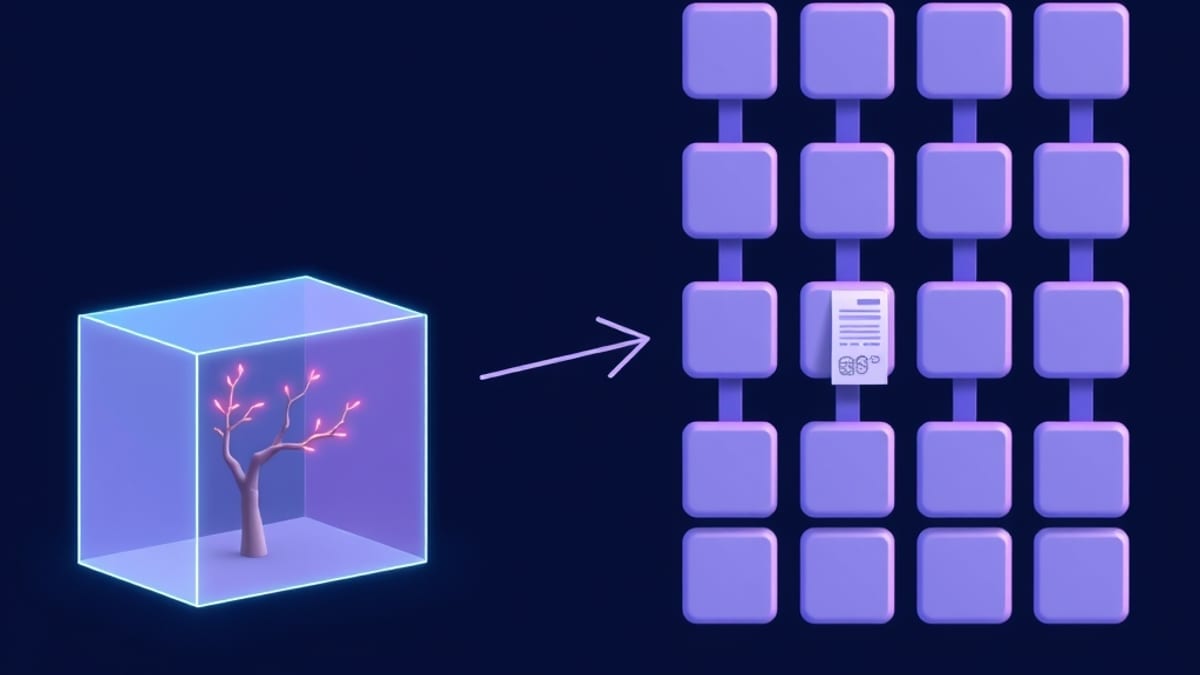
A working setup has four parts, and most failures come from getting the boundaries wrong.
The model runs off-chain. Inference is expensive and non-deterministic. You do not want to execute a neural network inside a smart contract — the gas cost alone makes it impractical, and floating-point math behaves differently across nodes, which breaks consensus. So the model runs where it always ran.
The output gets hashed. You take the decision, its inputs, and a model identifier, produce a cryptographic hash, and write that hash to the chain. The hash is small and fixed-size. The reasoning stays private.
A verification layer checks the work. Some designs use zero-knowledge proofs to show the computation was performed correctly without revealing the inputs. Others use optimistic schemes where results are accepted unless someone challenges them within a window.
Storage holds the evidence. The full input and output go to IPFS or a similar content-addressed store. The chain holds the pointer.
The critical constraint: on-chain verification costs money per transaction, and proof generation is computationally heavy. If your AI makes ten thousand decisions a day, you are batching, not writing each one individually.
A worked example: loan decisions with a verifiable trail
Say a lending platform processes 500 applications a day. Each application gets a risk score from a gradient-boosted model, and anything below a threshold gets declined.
The conventional approach: the model writes to a Postgres table, an engineer owns the table, and a regulator requesting the last 90 days of decisions gets a CSV export. Nothing is wrong with this until the export is disputed.
The decentralized version: each application's feature vector and score get hashed, and the hash is anchored on-chain in a daily Merkle batch. One on-chain transaction per day covers all 500 decisions. The full records sit in content-addressed storage. When the regulator asks, you hand them a Merkle proof for any individual application, and they verify it against the chain themselves — no trust in your database required.
What you gain: independent verifiability. What you pay: roughly a day of engineering work to build the batching pipeline, ongoing storage costs, and a new failure mode where a bad hash means an unverifiable decision. Also, your model can't be silently updated — every version change becomes a visible on-chain event, which some teams find uncomfortable.
Where this actually falls apart
Three honest limitations, in order of how often they bite.
Garbage in, immutably recorded. Blockchain guarantees the record wasn't altered. It says nothing about whether the input data was correct. If a fraudulent document enters your pipeline, you now have a permanent, cryptographically verified record of a bad decision. Immutability cuts both ways, and this is the failure mode people underestimate most.
Latency. Consensus takes time. If your use case needs a decision in under a second, you're either using a permissioned chain with a small validator set or you're not using a chain.
Privacy leakage. Hashes are pseudonymous, not anonymous. If the input space is small — say, a binary flag — an attacker can brute-force the hash and recover the original value. You need salting, and salting correctly is easy to get wrong.
There's also a cost question nobody likes answering. Public chain transaction fees fluctuate, and proof generation for complex models can dominate your compute budget. The internal tool database this site maintains, covering 360 AI tools with snapshots verified as recently as September 2026, tracks pricing and capability data for AI tooling — but blockchain infrastructure pricing moves independently and changes constantly. Check the vendor's own page rather than trusting any comparison table, including ours.
Where AI tooling fits, and where it doesn't
The AI side of this stack has a much lower barrier to entry than the blockchain side. Writing the model, the feature pipeline, and the documentation around a decision system is work that general-purpose AI tools handle reasonably well — with the caveat that anything touching regulated decision logic needs human review, because models will confidently produce plausible-looking compliance boilerplate that's wrong.
If prompt-writing overhead is the thing slowing you down, a zero-prompt generator like AI-Mind handles the drafting step without requiring you to construct detailed instructions first — useful for the documentation and internal-explainer layer, not for the model itself. The blockchain layer, by contrast, has no shortcut. Smart contract code is unforgiving, and a bug in a verification contract is worse than a bug in a normal one because you can't patch the historical record.
For teams thinking about the broader privacy implications of AI pipelines, this piece on using AI with your privacy intact covers the data-handling side that decentralized architectures often assume away. And if you're dealing with verification of AI-generated code specifically, this pattern for catching broken AI code is worth reading before you write a contract that can't be changed.
When to skip this entirely

If a single organization owns the model, the data, and the audit requirement, a signed append-only log with a trusted timestamp is cheaper, faster, and easier to operate. Blockchain earns its cost when trust is genuinely distributed — when multiple parties need to agree on a record and none of them wants to be the record-keeper.
That's a narrower condition than most writing on this topic admits. The convergence of AI and blockchain is real, but it's a solution to a coordination problem, not a general upgrade. Start by asking who needs to verify the decision and why they can't trust you to report it. If the answer is "nobody" or "they can," you don't need a chain.
Key Takeaways
- Decentralized intelligence records AI decisions on-chain so third parties can verify them without trusting the operator's database.
- Models run off-chain; only hashes and proofs go on-chain, because inference is too expensive and non-deterministic for consensus.
- Batching decisions into daily Merkle roots keeps transaction costs manageable for hundreds of daily decisions.
- Immutability preserves bad inputs as permanently as good ones — data quality problems don't disappear, they get notarized.
- If one party owns the model and the audit, a signed log is cheaper and better than a blockchain.
Sources
- AI Tool Database (internally verified snapshot), 2026. Internal catalog of 360 AI tools with pricing and capability snapshots recorded at verification time.
Frequently Asked Questions
Does the AI model itself run on the blockchain?
No, and it shouldn't. Neural network inference is computationally expensive and produces slightly different floating-point results across machines, which would break consensus. The model runs off-chain in a normal environment, and only a hash of its inputs, outputs, and model identifier gets written to the chain. This keeps costs low and preserves privacy while still creating a verifiable record.
How much does decentralized intelligence cost to run?
Costs split into three buckets: on-chain transaction fees, proof generation compute, and content-addressed storage. Transaction fees on public chains fluctuate significantly, and proof generation for complex models can exceed your inference budget. Because these prices move constantly and vary by chain, the vendor's own pricing page is the only reliable source. Any comparison table goes stale within weeks.
Can blockchain verification prove an AI decision was fair?
No. It proves the decision was recorded accurately and hasn't been altered since. Fairness depends on the training data, the model architecture, and the features you chose — none of which the chain can assess. A verifiable record of a biased decision is still a biased decision, just one you can't quietly edit later. Verification and fairness are separate problems that get conflated constantly.