AI Hardware Revolution: Specialized Chips Powering the Next Generation

The AI hardware chips and processors revolution is the enabling force behind every AI advancement that makes headlines. While software gets the attention, hardware creates the possibility. NVIDIA's dominance, the emergence of custom AI silicon from every major cloud provider, and the accelerating shift toward edge inference chips are reshaping who can build AI, where it runs, and what it costs. In 2026, AI hardware strategy is as strategically important as model selection — and the competitive dynamics are shifting rapidly.
NVIDIA's Dominance and the Challengers
NVIDIA's position in 2026 remains formidable but is under genuine competitive pressure for the first time. The H200 and B200 GPUs (Blackwell architecture) deliver roughly 4x the AI training performance of 2023's H100 at similar power consumption — a remarkable efficiency gain that keeps NVIDIA as the default choice for training large models. CUDA's software ecosystem — the libraries, frameworks, and tools built over 15 years — remains NVIDIA's deepest moat: switching hardware means rewriting software, and most organizations won't do that without compelling reasons.
But compelling reasons are emerging. Custom AI chips — Google's TPU v5, Amazon's Trainium2, Microsoft's Maia, and a growing ecosystem of startups like Cerebras and Groq — offer compelling price-performance for specific workloads. Google's TPUs power their own frontier models (Gemini) at roughly half the cost of equivalent NVIDIA infrastructure, and cloud customers increasingly choose TPU instances for large-scale training. AMD's MI300X offers competitive performance with better memory bandwidth than NVIDIA's flagship in certain configurations. AI technology breakthroughs latest in chip architecture include wafer-scale integration (Cerebras's dinner-plate-sized chips) and optical interconnects that dramatically reduce data movement bottlenecks between chips.
Edge AI: The Hardware Story That Matters Most for Practitioners
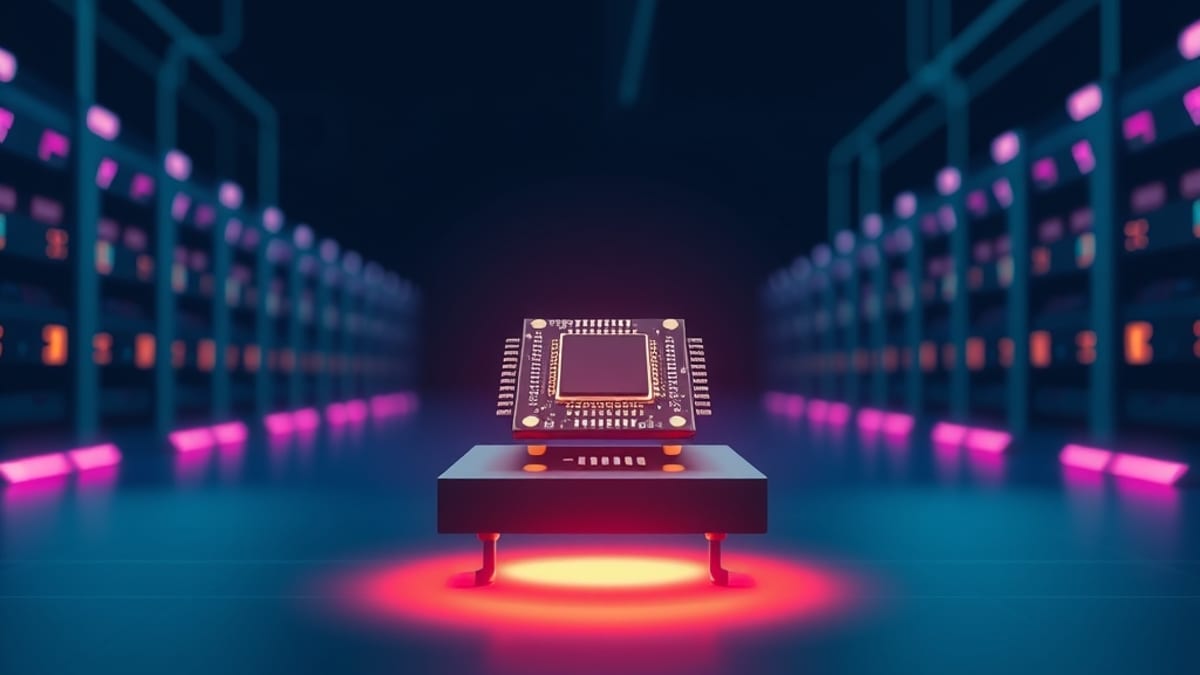
While training hardware captures attention, edge inference hardware is where the volume and practical impact live. Apple's Neural Engine in the M4 and A18 chips runs AI models entirely on-device for privacy and latency. Qualcomm's Snapdragon AI Engine powers AI capabilities on Android devices. Intel's Meteor Lake and Lunar Lake architectures integrate neural processing units directly into consumer and business laptops. Small language models edge computing AI running on this hardware is what makes real-time translation, on-device photo editing, and privacy-preserving personal assistants possible — not giant models in cloud data centers. The trend toward edge inference is democratizing AI access: organizations that cannot afford or cannot legally use cloud AI can deploy capable models on local hardware at costs that drop roughly 30-40% per generation. AI is leaving the data center and embedding into the physical world.
Related: I've explored this before in AI Writing vs Human Writing Quality Comparison.
Related: This connects to what I wrote about Zero Prompt AI Content Generation Guide.
Related: For more on this, see Zero Prompt AI Content Generation Guide.
How this article was produced: it was generated by an automated content pipeline from the sources listed above. No human editor wrote or reviewed it, and we did not personally test the tools described. Facts and prices that appear here come from our own AI tool database, and its verification date is noted where relevant. Spotted an error? Tell us and we will correct or remove it.
Want to try this yourself? AI-Mind generates content from a plain description — no prompt engineering required.
Try AI-Mind